The Manager Script Vault: Exact Scripts for Your First 90 Days in a New Role
Six copy-and-paste scripts for the trickiest conversations in your first three months, from setting up your 1-on-1s to raising blockers without sounding needy or incompetent.
Manager communication scripts are ready-to-use templates for the conversations new hires face most: asking for help, clarifying expectations, and sharing progress with a manager. Starting a new job comes with a unique kind of performance anxiety.
You want to demonstrate that you are proactive and capable, but you also need help navigating unfamiliar processes, unwritten team norms, and ambiguous expectations. As a result, many new hires fall into one of two traps:
- The Silent Struggler: You spend days trying to solve a problem in isolation because you are afraid to ask “dumb questions.”
- The Over-Communicator: You ping your manager every 20 minutes for validation, making them feel like they are managing your entire workday.
Succeeding in your first 90 days is not about knowing every answer on day one. It is about establishing clear, professional communication channels with your manager.
Here are six copy-and-paste scripts for the trickiest conversations you will encounter in your first three months. They show initiative while getting you the guidance you need.
1. Setting Up Your Early 1-on-1 Framework (Week 1)
Most managers want to support new hires, but they are often juggling competing priorities. If your manager has not set up a recurring 1-on-1 schedule by the end of your first week, take the initiative. Establish the cadence yourself.
Goal: Secure a dedicated 30-minute weekly check-in without placing administrative work on your manager.
Hi [Manager Name],

I am having a great first week getting up to speed on [Team Name / Project]. I want to make sure we stay aligned as I ramp up over the next few months.

Could we set up a recurring 30-minute weekly 1-on-1? I will own the agenda each week and send over a brief recap beforehand so we make the most of our time.

Let me know if Wednesdays or Thursdays usually work best for you.
2. How Do You Ask for Early Feedback Without Seeking Constant Validation (Week 2 to 3)?
Ask targeted questions tied to specific deliverables or behaviors. Asking “How am I doing?” is too broad. Busy managers often respond with a generic “You’re doing great!” which gives you zero actionable insight.
Goal: Get precise, constructive feedback on your speed and focus.
I finished my first pass on [Project / Task Name] yesterday. Before I move on to [Next Task], I would love your feedback on two specific areas:

First, did the depth of this work match your expectations for this phase?
Second, is there anything you would have prioritized differently?
3. Raising a Red Flag or Blocker Early (Week 3 to 6)
The biggest mistake new hires make is hiding a delay until a deadline is missed. Managers appreciate early heads-up alerts much more than late surprises. The key is to pair the problem with a proposed solution.
Goal: Flag a potential delay while proving you can problem-solve independently.
Hi [Manager Name],

I want to flag a potential blocker on [Project Name]. I am running into an issue with [Technical / Process Issue], which might push our target delivery from [Original Date] to [New Date].

I have already reached out to [Colleague / Team] to explore [Workaround], but I wanted to keep you informed. I will give you another update by tomorrow afternoon.
4. Asking to Shadow Cross-Functional Partners (Week 4 to 6)
Building context across the broader organization is key to moving from passive learner to active contributor. However, you want to reassure your manager that your primary responsibilities remain your top priority.
Goal: Expand your internal network without creating concern about your core bandwidth.
Now that I have a solid handle on my core daily tasks, I would like to better understand one thing. How does our work connect with [Partner Team, e.g., Product / Sales / Design]?

I am planning to ask [Colleague Name] if I can shadow one of their upcoming meetings this week. My primary focus remains on [Current Deliverable], but I think this context will help me ramp up faster.
5. Course-Correcting When Priorities Shift (Week 6 to 8)
In growing teams, priorities change constantly. When new urgent requests get added to your plate, you need a clear way to recalibrate your workload without sounding overwhelmed.
Goal: Force priority trade-offs in a collaborative, professional way.
I am excited to take on [New Request / Project]. To make sure I deliver this with high quality, I want to review my current bandwidth with you.

Right now, my main focus is on [Task A] and [Task B]. If we prioritize [New Request] for this week, should I pause work on [Task A], or extend the deadline for [Task B]?
6. Requesting a Formal 60-Day Progress Check-In (Month 2)
By day 60, you should be moving from learning to active contribution. Requesting a dedicated check-in at this milestone shows maturity and gives you time to course-correct before your final 90-day review.
Goal: Align on performance expectations and prepare for your end-of-quarter assessment.
Hard to believe I am approaching my 60-day mark!

In our next 1-on-1, I would love to dedicate 15 minutes to review my overall progress. I will bring a quick summary of what I have delivered so far, along with my main goals for Month 3. This makes sure we are completely aligned heading into my 90-day review.
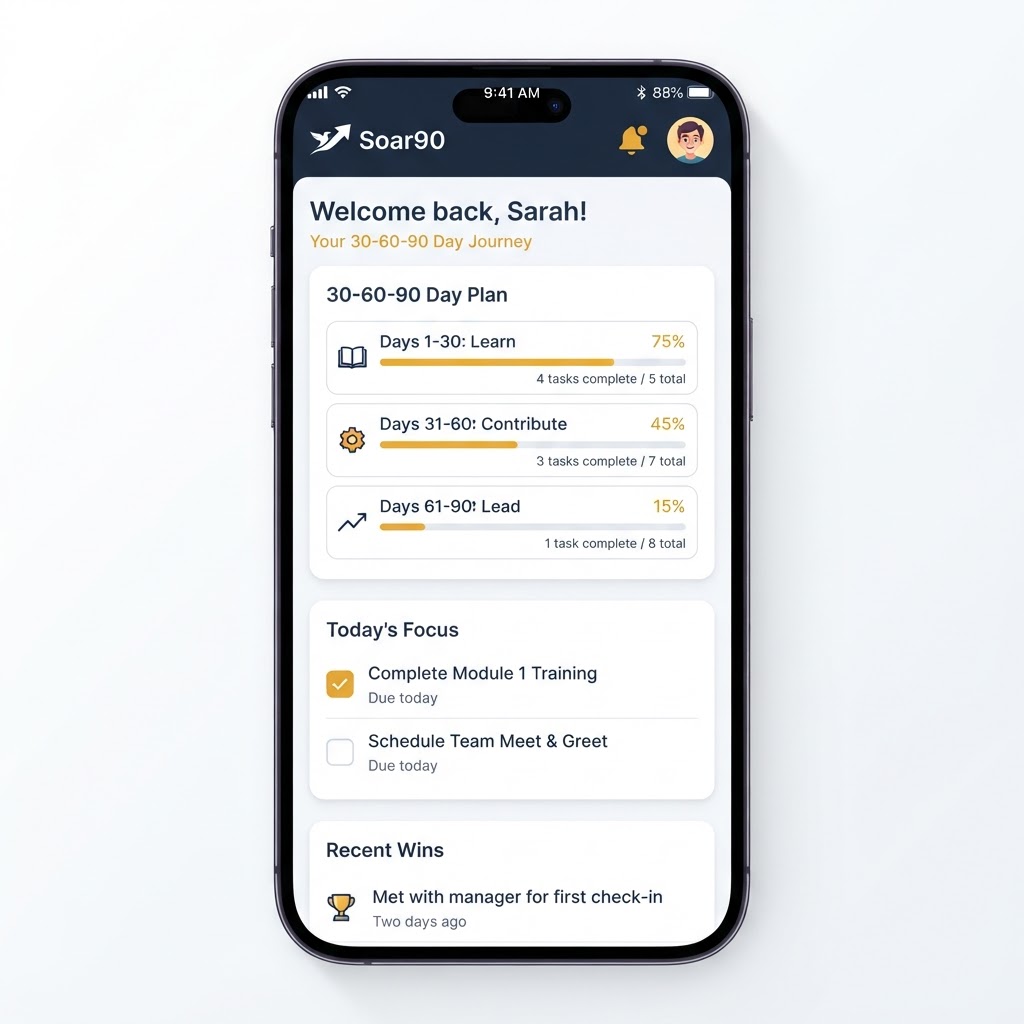
Want these scripts organized for you, with your wins tracked alongside them? Soar90 walks you through each conversation in your first 90 days.
Should You Document Your Conversations as You Go?
Yes, and immediately. Having these conversations is half the battle. The other half is keeping track of what you agreed upon.
Whenever you receive positive feedback, align on new priorities, or solve a blocker with your manager, record it immediately. Keep it in your Weekly Win Log. Keeping a consistent log prevents details from slipping through the cracks and gives you a factual, stress-free foundation when performance review time arrives.
Need a refresher on how to build a 5-minute weekly habit? Read our step-by-step guide on The Win Log Framework: How to Track Your Wins at Work.