30-60-90 Day Plan Examples for Six Real Roles
Real 30-60-90 day plan examples for sales, engineering, nursing, retail, people management, and remote roles. Copy the structure, swap in your own goals.
A 30-60-90 day plan example is a filled-in plan for a real role. It shows the specific goals, tasks, and milestones for each phase instead of the generic learn, contribute, lead.
Most 30-60-90 day plan advice tells you the phases. Learn in the first 30 days. Contribute in the next 30. Lead in the last 30.
That's fine, as far as it goes. But then you sit down to actually write your plan, and you stare at a blank page. "Learn what, exactly? Contribute how?"
That's where examples help. Not so you can copy them word for word, but so you can see what specific looks like for your kind of work.
I've been a recruiter for over a decade. I've watched hundreds of people start new jobs. The people who struggle wrote vague plans. The people who succeeded wrote specific ones. Same phases, very different results.
Here are six real 30-60-90 day plan examples, one each for sales, software engineering, nursing, retail management, people management, and remote work. Copy the structure, swap in your own goals.
What makes a 30-60-90 day plan example good?
A good example isn't a list of nice-sounding verbs. It does three things:
Specific actions. Not "build relationships." Instead: "Meet the five people my role touches most and ask each one what they wish my predecessor had known."
A way to prove it happened. Every phase should end with something you can point to. A deal closed. A feature shipped. A checklist passed. A report in your manager's hands.
Realistic scope. A 30-60-90 day plan with 40 tasks is a wish list, not a plan. Ten to fifteen items total is plenty.
Now, the examples.
30-60-90 Day Plan Example: Sales
Sales has the clearest milestones because the number does the talking. The trap is pushing for the number before you understand the product and the customer.
Days 1-30: Learn the product and the customer.
Shadow your top-performing teammate and take notes on their questions, not their pitch. Learn the CRM: how a lead is entered, qualified, and moved. Write down how your company defines a qualified opportunity, because every company defines it differently. Meet the marketing person who owns your content and the support person who hears the real complaints.
Days 31-60: Start the motion.
Own a small set of accounts or a starter territory. Send your first proposals. Run your first pipeline review with your manager and ask one question straight up. Ask: "What does a realistic ramp to full quota look like for me?" Sales managers respect that question. It shows you plan to hit the number.
Days 61-90: Show the number moving.
Work toward your full activity load and your first closed deals. Bring a clean pipeline to your 30, 60, and 90 day check-ins. By day 90 you want one honest sentence you can say: "Here is what is in my pipeline, and here is what closed. Here is what I learned that changes how I prospect."
30-60-90 Day Plan Example: Software Engineer
Engineering plans fail in one direction: going heads-down into code and skipping the people and the process.
Days 1-30: Ship something small, fast.
Get your development environment working and ship a small fix in your first two weeks. A tiny change, reviewed and merged, teaches you more than a week of reading documentation. Then read the parts of the codebase your team touches most. Learn the deployment process, the on-call runbook, and how code review actually works around here. Meet your product manager and your designer.
Days 31-60: Own a slice of something real.
Take a feature or a service slice from design through production, with help when you need it. Start reviewing other people's pull requests, even just small ones, so you learn the team's quality bar. Read one recent design doc a week to learn how decisions get made.
Days 61-90: Prove it end to end.
Ship a feature completely: design doc, implementation, tests, rollout. Leave the codebase a little better than you found it, with improved tests or docs in the places you touched. By day 90, propose one improvement you noticed during your first two months. New eyes see things veterans have stopped noticing.
30-60-90 Day Plan Example: Nurse
Hospital units run on protocol and trust. Your plan is about earning both, safely.
Days 1-30: Learn the unit's way of doing things.
Master the charting workflows in the EHR the way this unit does them. Learn the med pass, the handoff routines, and the escalation chain: who you call, in what order, when something looks wrong. Meet the charge nurses and the providers you'll work with most. Ask a senior nurse on the unit to be your go-to person.
Days 31-60: Take the full assignment.
Own your full patient assignment at the unit's normal pace. Practice escalating early rather than late, and say the concern out loud in handoff so nothing gets lost. Work through your competency checklists with your educator or preceptor.
Days 61-90: Show independence and look ahead.
Demonstrate that you can run the assignment without a safety net. Ask about precepting or committee participation, and map out your continuing education hours for the year. By day 90, your charge nurse should be able to describe your progress without checking with anyone first.
30-60-90 Day Plan Example: Retail Manager
Retail plans are won or lost on the team, not the tasks.
Days 1-30: Learn the operation and meet every person.
Work openings and closings so you see both ends of the day. Learn the inventory and ordering rhythm, the point of sale, and how schedules get built. Meet every team member individually and ask two questions: "What works here?" and "What is frustrating that someone with my title should fix?"
Days 31-60: Own something visible.
Take over a department, or the schedule, or the weekly numbers review. Fix one process problem your team told you about. This is the fastest trust-builder a new retail manager has: the team said it was broken, and you fixed it.
Days 61-90: Run the full operation.
Own the whole shift flow, staffing, and numbers. Put one improvement in place and measure it, whether that's shrink, conversion, or how long the truck takes to process. Present what changed to your store or district leader, with the before and after numbers.
30-60-90 Day Plan Example: New People Manager
The move from doing the work to leading the people is the hardest transition there is. The first 90 days set the pattern.
Days 1-30: Listen before you change anything.
Hold a first 1-on-1 with every team member and ask each one the same questions: What should this team keep doing? What should we stop? What do you need from me? Meet your own manager and get crystal clear on what success looks like for the team. Learn the review, promotion, and hiring processes you now own a piece of.
Days 31-60: Set direction and deliver feedback.
Agree on goals with each team member so expectations are written, not assumed. Give your first piece of real developmental feedback, kindly and specifically. Take ownership of one team routine that's already yours to run, like the weekly meeting.
Days 61-90: Show the pattern works.
Run the full meeting and planning cadence yourself. Make sure every team member can answer the question "What are we focused on and why?" Present a simple team roadmap to your manager. By day 90, your team should feel steered, not managed.
30-60-90 Day Plan Example: Remote Worker
Remote plans live and die on visibility. Out of sight really is out of mind, and your plan needs to fight that.
Days 1-30: Be visibly present.
Turn your camera on in the first stretch of meetings. Ask your manager directly about communication norms: which channel for what, and what response time is expected. Do short video intro chats with your closest teammates instead of text-only messages. Write down what you learn, because remote norms are rarely written anywhere else.
Days 31-60: Make your work findable.
Pick a rhythm for updates and keep it, for example a short note every Friday: what I did, what is next, where I am blocked. Ask about overlap hours and protect them for the collaborative work. Make sure your key deliverables are in a shared place, not buried in a private channel.
Days 61-90: Prove it with output.
Keep the update rhythm going and make it easy for your manager to summarize your impact to their manager. Write a one-page summary of your first 90 days before anyone asks for it. Propose one async improvement you noticed, like a meeting that could have been a document.
How do you adapt these examples to your own role?
Whatever your job is, run it through these five questions:
- What are the three things I must learn in my first 30 days to stop being dangerous?
- What is the smallest real contribution I can own by day 45 or 60?
- What can I point to by day 90 as proof?
- Who are the five people my role touches most, and have I met them?
- What's my cadence for showing my manager what I've done?
Write the answers down, put dates on them, and you have a 30-60-90 day plan.
One more thing: log your wins as you go. Every example above ends with proof, and proof comes from a record, not memory. A win log, five minutes a week, is the difference between "I feel like it went well" and "Here is what I did."
Turn Any Example Into Your Plan
You can keep all of this in a spreadsheet. Plenty of people do.
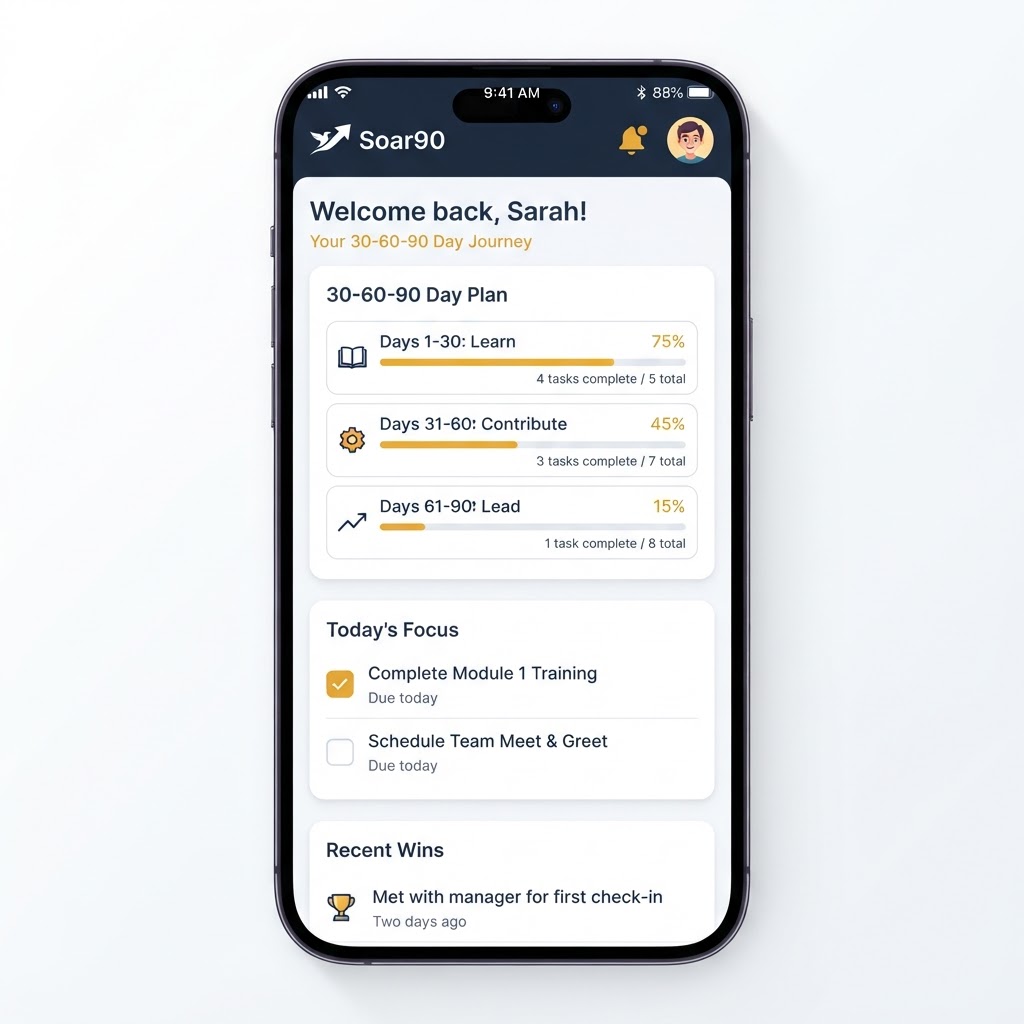
Or you can use Soar90, the app I built for exactly this. It gives you a daily task plan shaped for your role and track, and keeps your wins in a log as you go. One tap turns the whole thing into a review-ready report. It's $9.99 once, no subscription, and there's a free demo if you want to see how it works first.
The Bottom Line
The phases never change. Learn, contribute, prove. What changes is what those words mean for your specific job, and whether you wrote them down before the fog of week one hits.
Pick the example closest to your role, copy the structure, swap in your specifics, and start on day one.