How Do You Defeat Imposter Syndrome in a New Job?
Imposter syndrome is a pattern of doubting your skills even when the evidence says you are competent. Here is a repeatable system to quiet it in your first 90 days.
Imposter syndrome is a pattern of doubting your skills and feeling like a fraud even when evidence says you are competent. It is not a personal failing or an official diagnosis. You can manage it in a new job with a repeatable system. Name the feeling, track real evidence of your work, and give yourself a structured first 90 days. Then you stop waiting to feel ready.
What does imposter syndrome actually feel like at a new job?
Imposter syndrome feels like persistent self-doubt and a fear of being exposed as a fraud despite real competence. You may believe you fooled everyone into hiring you, and you may wait for someone to figure it out.
The experience is also called impostor phenomenon, impostorism, or impostor thoughts, according to Wikipedia. It is not a recognized psychiatric disorder in the DSM-5 or listed as a diagnosis in the ICD-11.
The imposter syndrome cycle typically follows a pattern, according to the Stanford Center for Teaching and Learning. You get a new task, feel anxiety, and either procrastinate or over-prepare. You finish the task and feel brief relief. Then you rationalize the success in negative ways, and the self-doubt returns stronger.
In a new job, this cycle shows up in small, specific moments. You reread a simple email five times before sending it. You stay late to hide that you feel behind. You assume the offer was a mistake or a stroke of luck. These moments feel private, but they are common signs of the same pattern.
How common is imposter syndrome, and who gets it?
Around 70 percent of adults may experience impostorism at least once in their lifetime, according to Psychology Today. The feeling is widespread, not rare.
Around 25 to 30 percent of high achievers may deal with imposter syndrome, according to Psychology Today. This matters for new hires because people landing competitive roles are often high performers with a history of achievement.

Photo by yi lu on Pexels
Psychologists Pauline Rose Clance and Suzanne Imes first described the phenomenon in 1978 after studying 150 high-achieving women, according to Deconstructing Stigma. Their research concluded that women were especially vulnerable to experiencing imposter syndrome, according to the Stanford Center for Teaching and Learning.
Later research shows the experience crosses gender and race lines. A 2017 study found that impostor syndrome, levels of depression, and survivor's guilt frequently co-occurred in Black college students, according to Deconstructing Stigma. About 70 percent of the population has experienced imposter syndrome at some point, according to NAMI.
Why does starting a new job trigger imposter syndrome so hard?
Starting a new job triggers imposter syndrome hard because the role removes your usual proof of competence. You have no track record yet, unfamiliar tools, unwritten rules, and a learning curve you cannot hide.
People with impostor syndrome have a higher chance of suffering from depression and anxiety, according to Wikipedia. The first weeks can feel heavier than the job itself because the emotional weight compounds the normal stress of onboarding.
A 2025 study conducted by the University of Idaho concluded that imposterism was strongly positively correlated with rigid and self-critical perfectionism, according to Wikipedia. This explains the over-preparing and the harsh inner critic that many new hires experience.
The trap is treating normal first-month confusion as proof you do not belong. Not knowing where a file lives or how a meeting runs is evidence of being new, not evidence of being a fraud. The Stanford Center for Teaching and Learning describes this as part of the cycle where success gets rationalized in negative ways.
What can you do in your first 90 days to quiet the doubt?
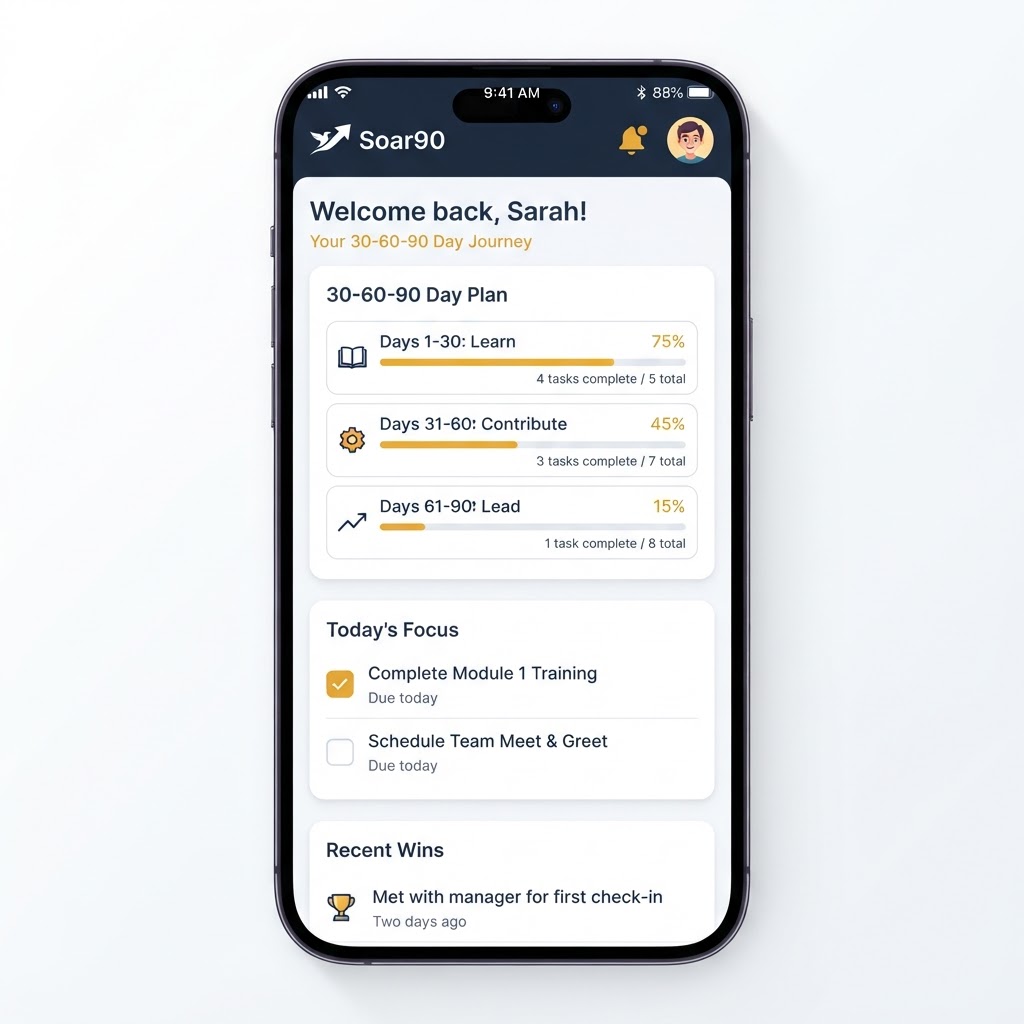
Break the first 90 days into phases with a small daily checklist so progress is visible instead of vague. A structured plan gives you dated evidence of what you learned and delivered, which counters the feeling that you are doing nothing.
Use a pre-boarding checklist before day one to cut the unknown. Uncertainty feeds the fraud feeling, so clarifying logistics, names, and expectations early reduces the mental load of your first week.
Write down one win per day, including small ones. Your memory will erase those wins by Friday, and the imposter cycle will fill the gap with a story about luck or low standards.
Add a short daily mantra and reflection prompt to interrupt the negative rationalizing step of the cycle. The Stanford Center for Teaching and Learning identifies that step as the moment where you discount the win and increase self-doubt. A simple written prompt can stop that spiral before it starts.
How do you track wins so the evidence beats the feeling?
A running win log works because it replaces the "I got lucky" story with dated, specific proof of contribution. When the fraud feeling spikes, you can read back what you actually did instead of arguing with your own memory.
Soar90 turns this into a system with a Win Log for documenting accomplishments and recognition, daily guidance tailored to any role, and a success tracker. The app is built for new hires who want a structured first 90 days.
The Review-Ready Report feature generates a progress report at one tap, so you can show your manager what you delivered without scrambling to reconstruct it. This matters when onboarding is thin and you need to build your own record.
Soar90 is available on iOS and Android with lifetime access for a one-time $9.99 purchase. A free demo is available with no signup or credit card required.
What should you say to yourself when the fraud feeling spikes?
Separate the feeling from the fact. Feeling unprepared is not the same as being unprepared, and the emotion does not change what you have already accomplished.
Use short, honest reframes you can repeat in the moment. "I am new, not incompetent" and "I was hired for a reason" are direct statements that interrupt the spiral without pretending the discomfort does not exist.
Ask for one piece of specific feedback instead of guessing what people think of you. The Stanford Center for Teaching and Learning notes that the imposter cycle feeds on anxiety and negative self-rationalizing, and a concrete answer from a manager cuts through that loop.
Remember the cycle has an end point each time. Naming the stage you are in, whether it is over-preparing or discounting a win, weakens its grip. The NAMI guidance points to awareness as a key step in managing the pattern.
When should you get extra support for imposter syndrome?
Watch for signs that imposter syndrome is spilling into sleep, mood, or daily function. Impostor syndrome often travels with anxiety and depression, according to Wikipedia, so the distress can become bigger than the job.
Talk to a manager, mentor, or trusted coworker about the work itself. A counselor or doctor can help with the emotional distress. Both steps are valid and serve different needs.
Self-tests exist, such as the 20-item Clance Impostor Phenomenon Scale and the 7-item Leary Impostor Scale, according to Wikipedia. These are screening tools, not diagnoses.
Imposter syndrome is not an official psychiatric diagnosis, according to Psychology Today. A professional can help you sort out what else may be going on and build a plan that fits your situation.
Key Takeaways
- Imposter syndrome is persistent self-doubt and a fraud feeling despite real competence, and it is not an official psychiatric diagnosis in the DSM-5 or ICD-11.
- Around 70 percent of adults may experience impostorism at least once in their lifetime, and about 25 to 30 percent of high achievers may deal with it.
- The impostor cycle runs from a new task to anxiety and over-preparing, to brief relief, to discounting the win, to more self-doubt.
- Clance and Imes coined the term in 1978 after studying 150 high-achieving women, and their work found women were especially vulnerable.
- A 2025 University of Idaho study found imposterism strongly correlated with rigid and self-critical perfectionism.
- Writing down daily wins creates dated evidence that counters the "I got lucky" story your brain tells.
- Soar90 is a $9.99 one-time iOS and Android app with a Win Log, daily guidance, and a Review-Ready Report, plus a free demo at https://soar90.com.
References
- Impostor syndrome, Wikipedia
- Imposter Syndrome, Stanford Center for Teaching and Learning
- Imposter Syndrome, Psychology Today, updated 2026-02-27
- Understanding Imposter Syndrome and How to Overcome It, NAMI
- Feeling Like a Fraud? A Deep Dive Into Impostor Syndrome, Deconstructing Stigma, updated 2026-08-17