How Do I Calm New Job Nerves and Build Good Relationships at Work?
New job nerves are normal and temporary. Here is how to calm first-day nerves with simple preparation, build relationships through small consistent actions, and track your progress.
New job nerves are the short-term worry and restlessness of your first days in a new role. They are normal, temporary, and shared by almost everyone starting out. They usually ease as routines and relationships take shape. You can calm first-day nerves with simple preparation and build positive working relationships through small consistent actions. Track your progress too, so confidence grows alongside your track record.
Why do I get so nervous when I start a new job?
You get nervous because a new job brings fear of the unknown: new people, new processes, and a new environment all arrive at once. Your brain is working hard to make sense of unfamiliar territory, and that mental load can feel overwhelming. According to Hays, a controllable sense of nervousness can actually help you perform at your best and make a positive first impression from day one.

Photo by Pavel Danilyuk on Pexels
Common causes include imposter syndrome, which RECRUITERS describes as the feeling that you tricked new employers into hiring you because you are not actually able to do the job. If that sounds familiar, our guide on how to defeat imposter syndrome in a new job breaks down a system to quiet it. The pressure to prove yourself quickly adds another layer. Losing familiar routines and coworkers also contributes, because you are grieving a known environment while adapting to a new one.
Stress and exhaustion are normal physical responses to learning so much at once. RECRUITERS notes that new processes, new faces, and unfamiliar systems all demand energy. Feeling tired does not mean you are failing. It means your body and mind are doing exactly what they should be doing during a major transition.
How long do new job nerves usually last?
New job nerves are temporary and often fade after the first few days. Hays advises that nervousness is a temporary feeling and that after a few days you will probably wonder what you were worried about. The first day feels the biggest because it carries the most unknowns.
Feeling nervous on day two, three, and four is completely normal. RECRUITERS states that it is normal to still feel nervous on the second, third, and fourth day, and that some nerves can last a number of weeks. There is no fixed timeline that works for everyone.
Getting fully up to speed takes weeks or months, and no one expects otherwise. Hays states it will take a few weeks and even months to get up to speed in a new role. RECRUITERS adds that grasping everything might take three months or even six. Anxiety lingering past three months is a signal to check in with yourself or a professional.
What do new job nerves feel like, and when should I get help?
New job nerves can show up as racing thoughts, trouble sleeping, stomach upset, and a general feeling of being clueless. MHA Screening states it is perfectly normal to feel nervous and even a little clueless when just starting out. Your body may feel on high alert even when nothing is actually wrong.
Panic attacks after starting a job can happen and are worth taking seriously. A panic attack may feel like a sudden rush of fear, a pounding heart, or shortness of breath. These episodes are not a character flaw, but they are a signal that your nervous system needs support.
Speak to a doctor if first-day jitters become more than normal or interfere with daily life. Hays advises speaking to a GP if first day jitters become more than normal. MHA Screening also notes that unpacking a difficult work experience with a trained peer counselor can help.
How can I calm my first-day-of-work nerves?
Prepare the night before. Hays recommends knowing what you are wearing, planning how to get there, and asking your new boss if there is any reading to prepare. Having these details settled removes last-minute decisions that can spike anxiety.
Contact your new manager before day one to build a connection and reduce fear of the unknown. Hays recommends this step as a way to lessen the fear of walking into a completely unfamiliar situation. A short message asking about first-day logistics is enough.
Lean on friends and family to keep things in perspective. Hays recommends talking to a support network such as friends or family. On the morning of day one, use simple calming techniques like slow breathing and arrive early so you have a moment to settle before things begin.
How do I build positive working relationships in a new job?
Start by being kind to yourself, learning from mistakes, and moving on quickly instead of dwelling. MHA Screening advises exactly this approach. New hires who forgive their own early errors recover faster and stay more open to connection.
Find your go-to people for questions about supplies, benefits, promotions, and lunch. MHA Screening recommends identifying these point people early. Having a named person for each practical question reduces uncertainty and creates natural conversation starters.
Remember your boss was once new too, and relationships with colleagues take time to develop naturally. MHA Screening advises keeping perspective by remembering that your boss was once in your shoes. RECRUITERS notes that loneliness can be the most surprising part of getting a new job, and that colleague relationships take a long time to develop naturally.
Reflect on your work style and share it with your team. MHA Screening suggests noting whether you prefer real-time feedback or scheduled meetings, and whether you work better in open offices or quiet spaces. Communicating these preferences helps coworkers understand how to work with you.
How does Soar90 help you manage new job nerves and build relationships?
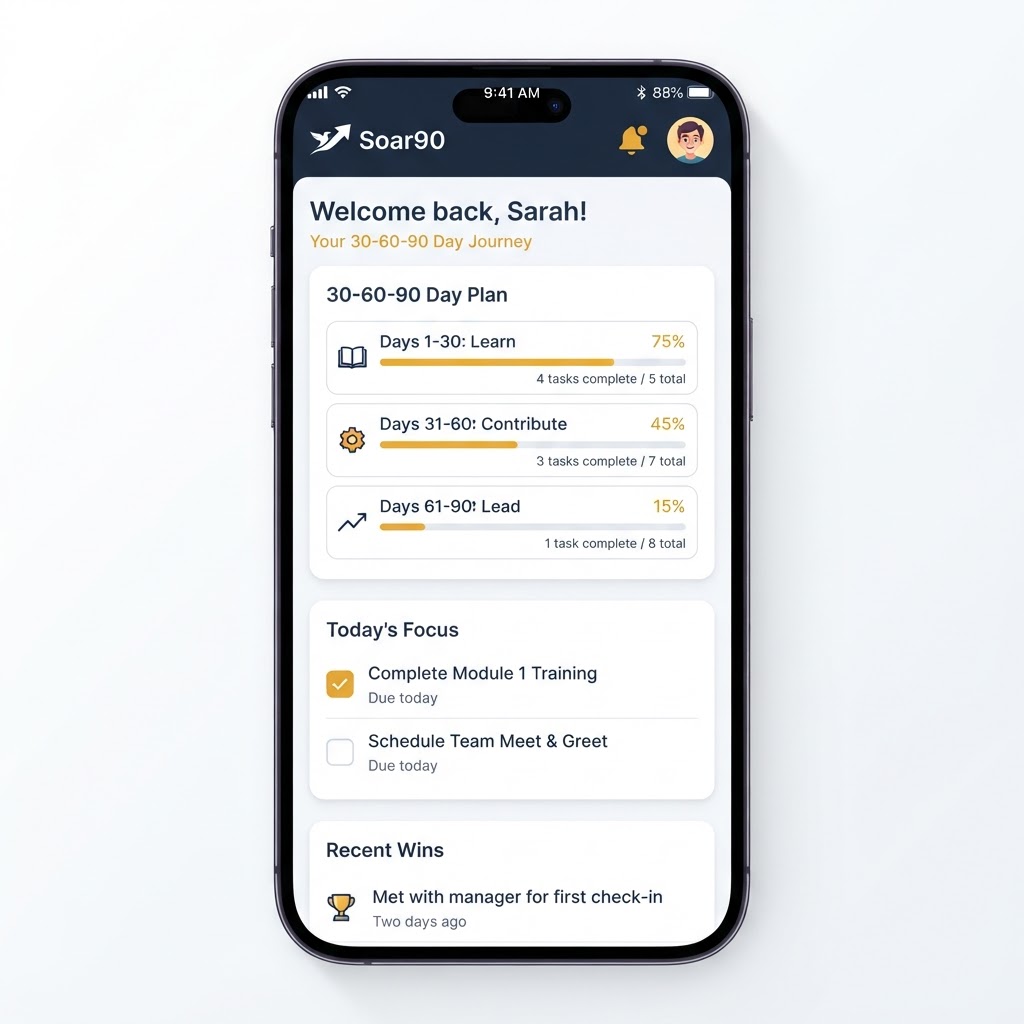
Soar90 is a self-guided success plan for anyone starting a new job or role, available on iOS and Android. The app gives anxious early weeks a clear structure instead of leaving you to guess what matters most. A 30-60-90 day roadmap and daily checklist provide phase-specific tasks, mantras, and reflection prompts that turn a big unknown into small daily steps.
The Win Log helps you document accomplishments and recognition as they happen. This builds confidence and creates a record you can point to when imposter feelings show up. Instead of wondering whether you are doing well, you can review specific evidence of your progress.
The Review-Ready Report generator turns your logged wins into a progress summary you can use in a check-in or review conversation. A pre-boarding checklist helps you prepare before day one. Weekly check-ins and daily email reminders keep the system moving without requiring constant willpower. Lifetime access costs $9.99 as a one-time purchase, and a free demo is available with no signup or credit card required.
What should I do if new job anxiety sticks around after three months?
Treat three months as a checkpoint, not a deadline, since settling in can take up to six months. RECRUITERS states that grasping everything in a new job might take three months or even six. Give yourself room to still be learning.
Review what you have learned and logged, and name specific wins to counter imposter feelings. MHA Screening advises being kind to yourself and learning from mistakes. A written list of accomplishments makes your progress visible. Our guide to new job anxiety covers more ways to manage the feeling and build momentum.
Ask for a check-in with your manager to clarify expectations and get feedback. If anxiety or depression persists, talk to a doctor or a trained counselor rather than pushing through alone. Hays and MHA Screening both point to professional support as a reasonable next step.
Does the advice change for a remote new job?
Yes, remote starts make relationship building harder because there is no hallway chat or casual break room conversation. You need to create those moments intentionally. Schedule short introductory calls with teammates and use video when possible so people can connect a face to your name.
Written check-ins and quick messages help you stay visible to your team. MHA Screening suggests finding your go-tos for questions, and in a remote role that often means identifying the right person to message for each type of question. Keep the same fundamentals: prepare early, ask questions, and document your wins.
Key Takeaways
- New job nerves are normal and expected, and they often fade after the first few days.
- Feeling nervous on day two, three, and four is completely normal, and some nerves can last a few weeks.
- Getting fully up to speed in a new role takes weeks or months, and no one expects you to know everything at once.
- Contacting your new manager before day one can reduce fear of the unknown and start the relationship early.
- Building relationships takes time, so find your go-to people for everyday questions and be patient with yourself.
- If first-day jitters become more than normal, speak to a doctor or a trained peer counselor.
- Soar90 offers a 30-60-90 day roadmap, daily checklist, Win Log, and Review-Ready Report for $9.99 one-time, with a free demo at https://soar90.com.
References
- 8 tips to ease new job nerves - Career development, Hays, date unknown
- I'm nervous about a new job, MHA Screening, date unknown
- Starting a new job? These 5 feelings are completely normal, RECRUITERS, date unknown