How Should I Prepare for Starting a New Job?
Preparing for a new job starts before day one. A simple three-track plan covering logistics, relationships, and a written record of your wins.
Preparing for a new job is the work you do before day one and through the first 90 days. It splits into three simple tracks: logistics, relationships, and a written record of what you accomplish. You do not need a perfect company onboarding program to succeed, because you can run your own structured plan starting today.

What should you do before your first day at a new job?
Start by confirming the practical basics: your start time, location or remote setup, dress code, parking or transit details, and the name of the person to ask for on day one. These small confirmations remove a surprising amount of first-day stress and help you walk in feeling steady instead of scattered.
Complete any pre-boarding paperwork before you arrive. According to Indeed, you should also gain access to company email, messaging platforms like Slack or Microsoft Teams, company VPNs, and workflow documents. Having your tools ready means your first hours can focus on people and context, not login screens.

Do a test run of everything you can. The Atlassian guide recommends a trial commute and a test of your tech setup before day one. If you are remote, check your camera, microphone, internet connection, and any software you will use. A dry run turns unknown variables into known ones.
Review the company's products, goals, competitors, vision, and structure so you arrive with context. Indeed lists these as key areas to understand early. You do not need deep expertise yet, but a working picture of what the company does and why will help you ask better questions from the first conversation.
Finally, write down why you wanted this job in the first place. James Gadsby Peet's LinkedIn article lists this as the first tip for starting a new job successfully. Keep that note somewhere you can see it, because the first few weeks can feel heavy and that written reason will anchor you.
What is the 30-60-90 rule for a new job?
The 30-60-90 rule is a phased roadmap for your first three months: learn in the first 30 days, contribute in the next 30, and lead or own outcomes by day 90. This structure gives you a clear arc instead of a vague hope that you will figure things out eventually.
Ask your manager what is expected in the first 30, 60, and 90 days. According to Indeed, you should also ask what exceeding expectations in the first 90 days would look like. That question turns a fuzzy standard into something you can actually aim for.

Set goals using the SMART method: specific, measurable, achievable, relevant, and time-bound. Indeed recommends defining success early and using SMART goals to do it. A goal like "learn the team's workflow" becomes stronger when you add a deadline and a way to show you have learned it.
Expect information overload in the first few weeks. Indeed states that the first few weeks on the job are information overload. The Unitemps guide advises digesting information one step at a time instead of trying to absorb everything at once. You are not failing because you cannot hold it all yet.
What should you say and do during your first week?
Use a simple self-introduction that includes your photo, role, key responsibilities, and a few hobbies. Indeed recommends this format because it gives coworkers an easy way to remember you and a natural opening for conversation.
If no one introduces you to coworkers after the first week, introduce yourself instead of waiting. Indeed advises taking this step yourself when a team lead does not do it. A short message or a quick hello in a meeting is enough to start building your network.
Ask coworkers about their preferred communication method and preferred check-in intervals. Indeed recommends this because every team has its own rhythm. Some people want a quick Slack message, others prefer email, and knowing the difference saves you from early friction.
Ask your manager which decisions they want to approve and which decisions you should make independently. This question, recommended by Indeed, clarifies your authority early and prevents you from either overstepping or waiting too long on small calls.
Schedule a virtual team lunch or after-work virtual hangout to build connections, especially in remote roles. Indeed suggests this as a way to create the casual interaction that remote work often lacks. Relationships built in the first week make the next 90 days smoother.
What habits help you succeed in the first 90 days?
Listen and write things down, and share your learning plan and learnings with your team as you go. The Coursera guide includes listening and writing things down among its tips, and a Reddit thread on starting a new job advises sharing your learning plan with your team. Visible learning builds trust faster than quiet effort.
Avoid criticizing anything early, including lack of technology, lack of perks, noise levels, excessive meetings, or process friction. Minoo Jha's Quora answer lists these as off-putting behaviors to avoid when settling into a new job. You have not earned the context to judge yet.
Do not complain about anything or anyone, including your commute, and do not compare your new company to your last one. The same Quora answer warns against both habits. Comparisons and complaints mark you as someone who brings friction rather than solving it.
Let your work speak instead of boasting, and never refuse low-level or tedious tasks outright. Quora contributor Minoo Jha advises both points directly. Early willingness on small tasks signals that you are reliable, and reliability earns bigger opportunities.
Be approachable and share your expertise so you become known as the go to person rather than holding tricks to yourself. Quora lists this as a key habit for settling in well. Generosity with your knowledge makes people want to work with you.
How do you track your wins and prepare for your first review?
Keep a running log of accomplishments, recognition, and moments when you helped someone, because memory fades by review time. Indeed and Coursera both emphasize the value of documenting your progress early. A written record turns scattered memories into evidence.
Note the date, the task, the outcome, and any numbers or names attached to each win. Specific details make your log useful later. "Helped the team ship a feature" is weak, while "On March 12, helped resolve a billing bug that affected 40 customers" is a fact you can use in a review.
Review your log before check-ins so you can speak to progress with evidence instead of vague summaries. When your manager asks what you have been working on, you can answer with specific examples rather than general impressions. This habit makes you look organized and aware of your own contribution.
Use your log to spot gaps against the 30-60-90 goals you set with your manager. If you planned to lead a project by day 90 but your log shows mostly support work, you can adjust before the review arrives. The log is a planning tool, not just a memory aid.
How does Soar90 help you prepare for a new job start?
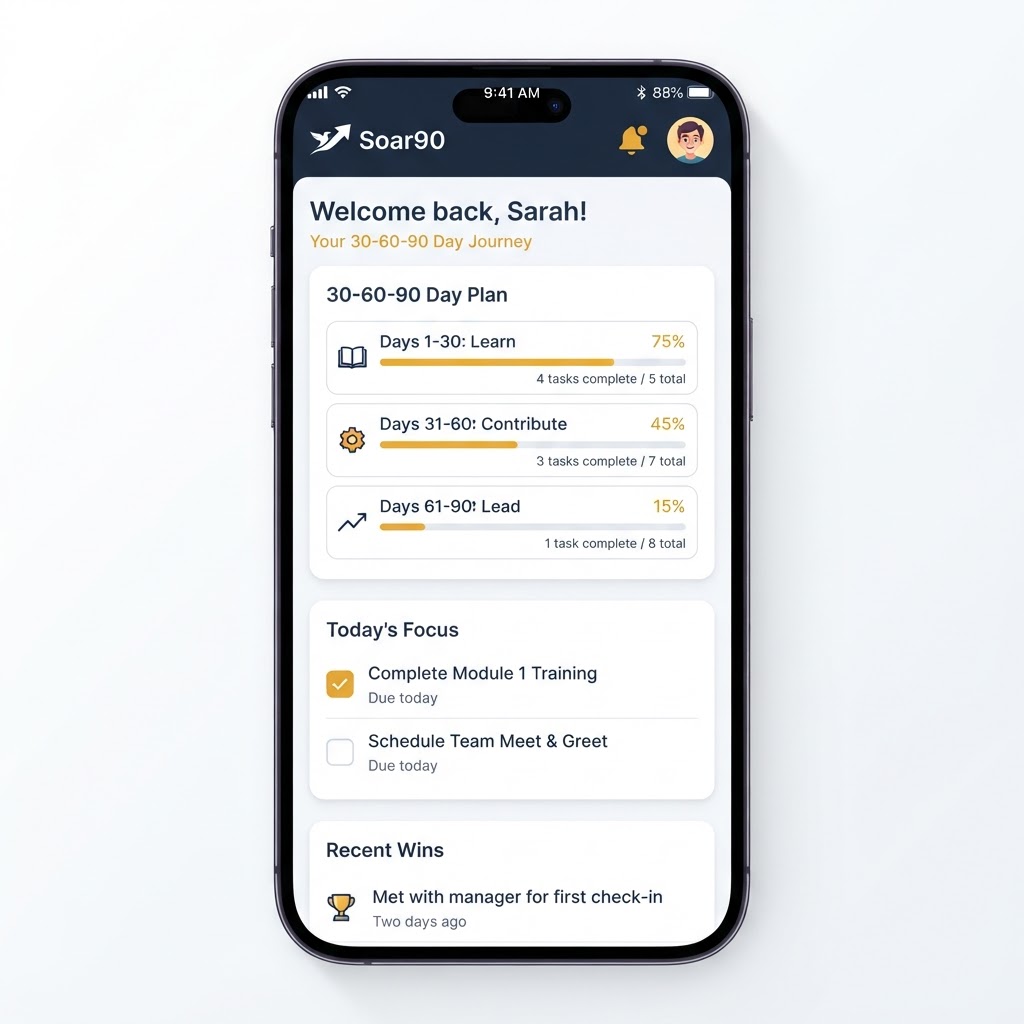
Soar90 is a self-guided success plan for anyone starting a new job or role, available on iOS and Android. The app gives you a 30-60-90 day roadmap with a daily checklist of phase-specific tasks, mantras, and reflection prompts. Each day tells you what to focus on based on where you are in your first three months.
The Win Log lets you document accomplishments and recognition as they happen, so nothing gets lost. Instead of trying to remember details weeks later, you record wins in the moment with the date, task, outcome, and any numbers attached. This creates a running record you can trust.
The Review-Ready Report generator turns your wins into a progress report at one tap, with AI-assisted or manual options. When your first review approaches, you have a structured summary ready without scrambling to reconstruct the past 90 days from memory.
A pre-boarding checklist covers the days before day one, and weekly check-ins plus daily email reminders keep you on track. Lifetime access is a one-time purchase of $9.99, and there is a free demo with no signup or credit card required at https://soar90.com.
What should you avoid doing in your first month?
Do not take long lunches, leave early, request time off, or arrive late to meetings before you have proven your value. Minoo Jha's Quora answer lists these as behaviors to avoid until you have established a track record. Early flexibility is earned, not assumed.
Do not be loud, obnoxious, take people's things without asking, or leave dirty plates around shared spaces. The same Quora answer includes these basic respect points. Small courtesies shape how people read your character in the first month.
Do not hold your knowledge back from teammates who need help. Quora advises sharing expertise and becoming known as the go to person rather than keeping tricks to yourself. Hoarding knowledge isolates you, while sharing it builds allies.
Do not assume silence means approval; ask your manager directly when you are unsure about a decision. Indeed recommends clarifying decision authority early. A quick question prevents a mistake that could take weeks to repair.
How do you handle the emotional ups and downs of a new job?
Expect the first weeks to feel like information overload, and treat that as normal rather than a sign you made a mistake. Indeed states that the first few weeks on the job are information overload. Feeling overwhelmed is a predictable phase, not a personal failing.
Get ready for the suck: some days will be hard, and naming that in advance makes it easier to push through. James Gadsby Peet's LinkedIn article lists this as its second tip. When you expect difficulty, a hard day feels like part of the plan rather than a crisis.
Practice self-care and be confident, since patience with yourself goes further than you expect. The Unitemps guide includes self-care and confidence among its nine steps. Rest, food, and movement are not luxuries during a job transition; they are part of performing well.
Return to your written reason for taking the job when motivation dips, and lean on small daily wins to rebuild momentum. The note you wrote before day one becomes a touchstone on tough days. A single completed task, logged and acknowledged, can restart a stalled week.
Key Takeaways
- Preparing for a new job starts before day one with logistics, access to tools, and company research.
- The 30-60-90 rule splits your first three months into learning, contributing, and owning outcomes.
- Asking your manager what exceeding expectations looks like turns vague hopes into measurable goals.
- A written win log with dates, outcomes, and numbers makes your first review far easier to handle.
- Simple habits like writing things down and sharing your learning plan build trust with your team fast.
- Avoiding complaints, comparisons, and early schedule flexibility protects your reputation in the first month.
- Soar90 offers a 30-60-90 day roadmap, Win Log, and Review-Ready Report for a one-time $9.99 purchase with a free demo at https://soar90.com.
References
- How To Succeed in Your New Job: First Week, 30 and 90 Days - updated 2026-06-15
- 10 expert tips for starting a new job - date unknown
- 5 Tips for starting a new job successfully - date unknown
- Starting a New Job: 18 Tips for Early and Ongoing Success - date unknown
- Nine step guide for successfully starting a new job - date unknown
- What are some advice for starting a new job? - date unknown
- What are your tips / strategies for starting a new job off on the right foot? - date unknown